MocKAT
Dashboard
FREE
Daily Quiz
Daily PoV
Daily News
PYQs
PREP
Study Plan
Quant
VARC
DILR
Speed
TESTS
Mocks & Tests
MORE
Info & Colleges
Plans & Pricing
Home›PYQs›CAT 2020›Slot 1 DILR
CAT 2020DILRSlot 1 · Morning

CAT 2020 Slot 1 DILR Question Paper with Solutions

40 Minutes24 QuestionsNov 29, 20203 marks correct · −1 wrong
Take Full Mock
Questions
0 / 24 answered0 correct0 wrong
RC

Passage 1 · CAT2020Slot1_DILR1 · 6 Questions

Read the following and answer the Questions that follow

In a certain board examination, students were to appear for examination in five subjects: English, Hindi, Mathematics, Science and Social Science. Due to a certain emergency situation, a few of the examinations could not be conducted for some students. Hence, some students missed one examination and some others missed two examinations. Nobody missed more than two examinations.

The board adopted the following policy for awarding marks to students. If a student appeared in all five examinations, then the marks awarded in each of the examinations were on the basis of the scores obtained by them in those examinations.

If a student missed only one examination, then the marks awarded in that examination was the average of the best three among the four scores in the examinations they appeared for.

If a student missed two examinations, then the marks awarded in each of these examinations was the average of the best two among the three scores in the examinations they appeared for.

The marks obtained by six students in the examination are given in the table below. Each of them missed either one or two examinations.

EnglishHindiMathematicsScienceSocial Science
Alva8075707560
Bithi9080558585
Carl75809010090
Deep70901009080
Esha8085956055
Foni8372788883


The following facts are also known.
I. Four of these students appeared in each of the English, Hindi, Science, and Social Science examinations.
II. The student who missed the Mathematics examination did not miss any other examination.
III. One of the students who missed the Hindi examination did not miss any other examination. The other student who missed the Hindi examination also missed the Science examination.
Q1CAT 2020 Slot 1 DILR
View Standalone Page
Who among the following did not appear for the Mathematics examination?
Q2CAT 2020 Slot 1 DILR
View Standalone Page
Which students did not appear for the English examination?
Q3CAT 2020 Slot 1 DILR
View Standalone Page
What BEST can be concluded about the students who did not appear for the Hindi examination?
Q4CAT 2020 Slot 1 DILR
View Standalone Page
What BEST can be concluded about the students who missed the Science examination?
Q5CAT 2020 Slot 1 DILR
View Standalone Page
How many out of these six students missed exactly one examination?
Type your answer
Q6CAT 2020 Slot 1 DILR
View Standalone Page
For how many students can we be definite about which examinations they missed?
Type your answer
RC

Passage 2 · CAT2020Slot1_DILR2 · 6 Questions

Read the following and answer the Questions that follow

Four institutes, A, B, C, and D, had contracts with four vendors W, X, Y, and Z during the ten calendar years from 2010 to 2019. The contracts were either multi-year contracts running for several consecutive years or single-year contracts. No institute had more than one contract with the same vendor. However, in a calendar year, an institute may have had contracts with multiple vendors, and a vendor may have had contracts with multiple institutes. It is known that over the decade, the institutes each got into two contracts with two of these vendors, and each vendor got into two contracts with two of these institutes.

The following facts are also known about these contracts.
I. Vendor Z had at least one contract in every year.
II. Vendor X had one or more contracts in every year up to 2015, but no contract in any year after that.
III. Vendor Y had contracts in 2010 and 2019. Vendor W had contracts only in 2012.
IV. There were five contracts in 2012.
V. There were exactly four multi-year contracts. Institute B had a 7-year contract, D had a 4-year contract, and A and C had one 3-year contract each. The other four contracts were single-year contracts.
VI. Institute C had one or more contracts in 2012 but did not have any contract in 2011.
VII. Institutes B and D each had exactly one contract in 2012. Institute D did not have any contract in 2010.
Q7CAT 2020 Slot 1 DILR
View Standalone Page
In which of the following years were there two or more contracts?
Q8CAT 2020 Slot 1 DILR
View Standalone Page
Which of the following is true?
Q9CAT 2020 Slot 1 DILR
View Standalone Page
In how many years during this period was there only one contract?
Q10CAT 2020 Slot 1 DILR
View Standalone Page
What BEST can be concluded about the number of contracts in 2010?
Q11CAT 2020 Slot 1 DILR
View Standalone Page
Which institutes had multiple contracts during the same year?
Q12CAT 2020 Slot 1 DILR
View Standalone Page
Which institutes and vendors had more than one contracts in any year?
RC

Passage 3 · CAT2020Slot1_DILR3 · 4 Questions

Read the following and answer the Questions that follow

Ten musicians (A, B, C, D, E, F, G, H, I and J) are experts in at least one of the following three percussion instruments: tabla, mridangam, and ghatam. Among them, three are experts in tabla but not in mridangam or ghatam, another three are experts in mridangam but not in tabla or ghatam, and one is an expert in ghatam but not in tabla or mridangam. Further, two are experts in tabla and mridangam but not in ghatam, and one is an expert in tabla and ghatam but not in mridangam.

The following facts are known about these ten musicians.

Both A and B are experts in mridangam, but only one of them is also an expert in tabla.
D is an expert in both tabla and ghatam.
Both F and G are experts in tabla, but only one of them is also an expert in mridangam.
Neither I nor J is an expert in tabla.
Neither H nor I is an expert in mridangam, but only one of them is an expert in ghatam.
Q13CAT 2020 Slot 1 DILR
View Standalone Page
Who among the following is DEFINITELY an expert in tabla but not in either mridangam or ghatam?
Q14CAT 2020 Slot 1 DILR
View Standalone Page
Who among the following is DEFINITELY an expert in mridangam but not in either tabla or ghatam?
Q15CAT 2020 Slot 1 DILR
View Standalone Page
Which of the following pairs CANNOT have any musician who is an expert in both tabla and mridangam but not in ghatam?
Q16CAT 2020 Slot 1 DILR
View Standalone Page
If C is an expert in mridangam and F is not, then which are the three musicians who are experts in tabla but not in either mridangam or ghatam?
RC

Passage 4 · CAT2020Slot1_DILR4 · 4 Questions

Read the following and answer the Questions that follow

1000 patients currently suffering from a disease were selected to study the effectiveness of treatment of four types of medicines — A, B, C and D. These patients were first randomly assigned into two groups of equal size, called treatment group and control group. The patients in the control group were not treated with any of these medicines; instead they were given a dummy medicine, called placebo, containing only sugar and starch. The following information is known about the patients in the treatment group.

a. A total of 250 patients were treated with type A medicine and a total of 210 patients were treated with type C medicine.
b. 25 patients were treated with type A medicine only. 20 patients were treated with type C medicine only. 10 patients were treated with type D medicine only.
c. 35 patients were treated with type A and type D medicines only. 20 patients were treated with type A and type B medicines only. 30 patients were treated with type A and type C medicines only. 20 patients were treated with type C and type D medicines only.
d. 100 patients were treated with exactly three types of medicines.
e. 40 patients were treated with medicines of types A, B and C, but not with medicines of type D. 20 patients were treated with medicines of types A, C and D, but not with medicines of type B.
f. 50 patients were given all the four types of medicines. 75 patients were treated with exactly one type of medicine.
Q17CAT 2020 Slot 1 DILR
View Standalone Page
How many patients were treated with medicine type B?
Type your answer
Q18CAT 2020 Slot 1 DILR
View Standalone Page
The number of patients who were treated with medicine types B, C and D, but not type A was:
Type your answer
Q19CAT 2020 Slot 1 DILR
View Standalone Page
How many patients were treated with medicine types B and D only?
Type your answer
Q20CAT 2020 Slot 1 DILR
View Standalone Page
The number of patients who were treated with medicine type D was:
Type your answer
RC

Passage 5 · CAT2020Slot1_DILR5 · 4 Questions

Read the following and answer the Questions that follow

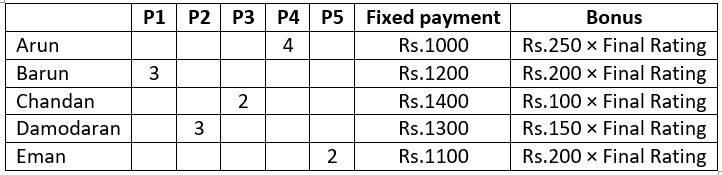
The local office of the APP-CAB company evaluates the performance of five cab drivers, Arun, Barun, Chandan, Damodaran, and Eman for their monthly payment based on ratings in five different parameters (P1 to P5) as given below:

P1: timely arrival
P2: behaviour
P3: comfortable ride
P4: driver's familiarity with the route
P5: value for money
Based on feedback from the customers, the office assigns a rating from 1 to 5 in each of these parameters. Each rating is an integer from a low value of 1 to a high value of 5. The final rating of a driver is the average of his ratings in these five parameters. The monthly payment of the drivers has two parts – a fixed payment and final rating-based bonus. If a driver gets a rating of 1 in any of the parameters, he is not eligible to get bonus. To be eligible for bonus a driver also needs to get a rating of five in at least one of the parameters.

The partial information related to the ratings of the drivers in different parameters and the monthly payment structure (in rupees) is given in the table below:


The following additional facts are known.

1. Arun and Barun have got a rating of 5 in exactly one of the parameters. Chandan has got a rating of 5 in exactly two parameters.
2. None of drivers has got the same rating in three parameters.
Q21CAT 2020 Slot 1 DILR
View Standalone Page
If Damodaran does not get a bonus, what is the maximum possible value of his final rating?
Q22CAT 2020 Slot 1 DILR
View Standalone Page
If Eman gets a bonus, what is the minimum possible value of his final rating?
Q23CAT 2020 Slot 1 DILR
View Standalone Page
If all five drivers get bonus, what is the minimum possible value of the monthly payment (in rupees) that a driver gets?
Q24CAT 2020 Slot 1 DILR
View Standalone Page
If all five drivers get bonus, what is the maximum possible value of the monthly payment (in rupees) that a driver gets?

About CAT 2020 Slot 1 DILR

The DILR section of CAT 2020 Slot 1 was conducted on November 30, 2020, the last Sunday of November — consistent with IIM's scheduling across all recent years. The section contains 24 questions to be answered in 40 minutes, carrying 72 marks in total. There is no sectional time limit within the overall exam, but students choosing to switch sections mid-paper lose the ability to return — making pacing within DILR critical.

Passage Topics in CAT 2020 Slot 1 DILR

CAT 2020 Slot 1 DILR featured four reading comprehension passages and a standalone Verbal Ability block. The RC passages spanned complexity theory and global systems, the aesthetics of electronic music, the economics of income inequality, and the legal history of criminal responsibility — a typical CAT spread across the sciences, humanities, and social sciences. The VA section included Para Jumbles, Para Summary, and Odd Sentence Out questions, consistent with the pattern since CAT 2019.

CAT 2020 DILR Marking Scheme

  • Correct answer (MCQ): +3 marks
  • Wrong answer (MCQ): −1 mark
  • Unattempted (MCQ): 0 marks
  • TITA questions (if any): +3 correct, no negative marking

How to Use This Question Paper

Click any answer option to immediately check your answer. The correct option is highlighted in green; if you selected the wrong option, it is shown in red and the correct answer is revealed. A detailed explanation appears below each question after you answer it, along with statistics showing what percentage of students answered correctly in the actual exam.

The question navigator at the top of the page updates in real time — green bubbles indicate correct answers and red indicate wrong. Use this to spot weak areas at a glance. To practice under timed conditions, use the Take Full Mock button to attempt the complete CAT 2020 Slot 1 paper with a live timer and percentile benchmarking.

Tips for CAT DILR Preparation

Reading Comprehension accounts for roughly two-thirds of the DILR section. The passages in CAT are dense and argumentative — they reward close reading of the author's position rather than skimming for facts. Practising on past papers is the most reliable way to calibrate your reading speed, improve inference accuracy, and recognise the types of questions IIM setters favour. Use the answer statistics on this page to benchmark yourself; questions where more than 50% of test-takers answered correctly are ones you should aim to get right every time.

Attempt Full CAT 2025 Mock

Take the complete Slot 1 paper with live timer, percentile, and section-wise analytics.

  • All 3 sections · 68 questions
  • Real exam timer & percentile rank
  • Detailed performance report
Take Full Mock
Vignesh & Sanjana
SELF STUDY
Your prep, planned daily.
Everything unlocked — and the Study Planner turns it into a simple day-by-day schedule.
TODAY
Weakest topic · Video Lesson
35 min
THU
L1 → L2 Practice Set
40 min
FRI
Booster Quiz ×2 + Speed Drill
30 min
✓120+ hours of Video Lessons
✓2400+ L1/L2/L3 Practice Questions
✓700+ Daily Quizzes
✓750 Booster Quizzes
✓Access to all Speed Modules
Upgrade to Self Study →
compare all plans

Other DILR Papers

CAT 2020 · All slots

    CAT 2020 Slot 2 DILR
    24Q · Nov 30, 2020
    ›
    CAT 2020 Slot 3 DILR
    24Q · Nov 30, 2020
    ›
    CAT 2019 Slot 1 DILR
    24Q · Nov 24, 2019
    ›
    CAT 2018 Slot 1 DILR
    24Q · Nov 26, 2018
    ›