
CAT 2023 Slot 1 DILR Question Paper with Solutions
Passage 1 · CAT2023Slot1_DILR1 · 5 Questions
Five restaurants, coded R1, R2, R3, R4 and R5 gave integer ratings to five gig workers – Ullas, Vasu, Waman, Xavier and Yusuf, on a scale of 1 to 5.
The means of the ratings given by R1, R2, R3, R4 and R5 were 3.4, 2.2, 3.8, 2.8 and 3.4 respectively.
The summary statistics of these ratings for the five workers is given below.
| Ullas | Vasu | Waman | Xavier | Yusuf | |
|---|---|---|---|---|---|
| Mean rating | 2.2 | 3.8 | 3.4 | 3.6 | 2.6 |
| Median rating | 2 | 4 | 4 | 4 | 3 |
| Modal rating | 2 | 4 | 5 | 5 | 1 and 4 |
| Range of rating* | 3 | 3 | 4 | 4 | 3 |
Range of ratings is defined as the difference between the maximum and minimum ratings awarded to a worker.
The following is partial information about ratings of 1 and 5 awarded by the restaurants to the workers.
(a) R1 awarded a rating of 5 to Waman, as did R2 to Xavier, R3 to Waman and Xavier, and R5 to Vasu.
(b) R1 awarded a rating of 1 to Ullas, as did R2 to Waman and Yusuf, and R3 to Yusuf.
Passage 2 · CAT2023Slot1_DILR2 · 5 Questions
The schematic diagram below shows 12 rectangular houses in a housing complex. House numbers are mentioned in the rectangles representing the houses. The houses are located in six columns – Column-A through Column-F, and two rows – Row-1 and Row-2. The houses are divided into two blocks - Block XX and Block YY. The diagram also shows two roads, one passing in front of the houses in Row-2 and another between the two blocks.
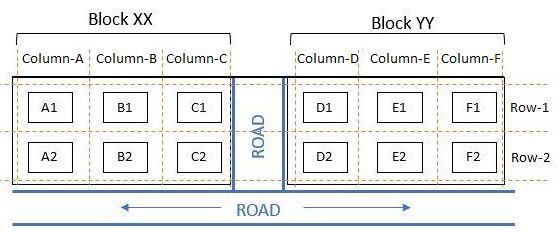
Some of the houses are occupied. The remaining ones are vacant and are the only ones available for sale.
The road adjacency value of a house is the number of its sides adjacent to a road. For example, the road adjacency values of C2, F2, and B1 are 2, 1, and 0, respectively. The neighbour count of a house is the number of sides of that house adjacent to occupied houses in the same block. For example, E1 and C1 can have the maximum possible neighbour counts of 3 and 2, respectively.
The base price of a vacant house is Rs. 10 lakhs if the house does not have a parking space, and Rs. 12 lakhs if it does. The quoted price (in lakhs of Rs.) of a vacant house is calculated as .
The following information is also known.
1. The maximum quoted price of a house in Block XX is Rs. 24 lakhs. The minimum quoted price of a house in block YY is Rs. 15 lakhs, and one such house is in Column-E.
2. Row-1 has two occupied houses, one in each block.
3. Both houses in Column-E are vacant. Each of Column-D and Column-F has at least one occupied house.
4. There is only one house with parking space in Block YY.
Passage 3 · CAT2023Slot1_DILR3 · 5 Questions
A visa processing office (VPO) accepts visa applications in four categories – US, UK, Schengen, and Others. The applications are scheduled for processing in twenty 15-minute slots starting at 9:00 am and ending at 2:00 pm. Ten applications are scheduled in each slot.
There are ten counters in the office, four dedicated to US applications, and two each for UK applications, Schengen applications and Others applications. Applicants are called in for processing sequentially on a first-come-first-served basis whenever a counter gets freed for their category. The processing time for an application is the same within each category. But it may vary across the categories. Each US and UK application requires 10 minutes of processing time. Depending on the number of applications in a category and time required to process an application for that category, it is possible that an applicant for a slot may be processed later.
On a particular day, Ira, Vijay and Nandini were scheduled for Schengen visa processing in that order. They had a 9:15 am slot but entered the VPO at 9:20 am. When they entered the office, exactly six out of the ten counters were either processing applications, or had finished processing one and ready to start processing the next.
Mahira and Osman were scheduled in the 9:30 am slot on that day for visa processing in the Others category.
The following additional information is known about that day.
1. All slots were full.
2. The number of US applications was the same in all the slots. The same was true for the other three categories.
3. 50% of the applications were US applications.
4. All applicants except Ira, Vijay and Nandini arrived on time.
5. Vijay was called to a counter at 9:25 am.
Passage 4 · CAT2023Slot1_DILR4 · 5 Questions
Faculty members in a management school can belong to one of four departments – Finance and Accounting (F&A), Marketing and Strategy (M&S), Operations and Quants (O&Q) and Behaviour and Human Resources (B&H). The numbers of faculty members in F&A, M&S, O&Q and B&H departments are 9, 7, 5 and 3 respectively.
Prof. Pakrasi, Prof. Qureshi, Prof. Ramaswamy and Prof. Samuel are four members of the school's faculty who were candidates for the post of the Dean of the school. Only one of the candidates was from O&Q.
Every faculty member, including the four candidates, voted for the post. In each department, all the faculty members who were not candidates voted for the same candidate. The rules for the election are listed below.
1. There cannot be more than two candidates from a single department.
2. A candidate cannot vote for himself/herself.
3. Faculty members cannot vote for a candidate from their own department.
After the election, it was observed that Prof. Pakrasi received 3 votes, Prof. Qureshi received 14 votes, Prof. Ramaswamy received 6 votes and Prof. Samuel received 1 vote. Prof. Pakrasi voted for Prof. Ramaswamy, Prof. Qureshi for Prof. Samuel, Prof. Ramaswamy for Prof. Qureshi and Prof. Samuel for Prof. Pakrasi.
Statement A: Prof. Pakrasi belongs to M&S.
Statement B: Prof. Ramaswamy belongs to O&Q.
Statement A: Non-candidates from M&S voted for Prof. Qureshi.
Statement B: Non-candidates from F&A voted for Prof. Qureshi.
About CAT 2023 Slot 1 DILR
The DILR section of CAT 2023 Slot 1 was conducted on November 30, 2023, the last Sunday of November — consistent with IIM's scheduling across all recent years. The section contains 24 questions to be answered in 40 minutes, carrying 72 marks in total. There is no sectional time limit within the overall exam, but students choosing to switch sections mid-paper lose the ability to return — making pacing within DILR critical.
Passage Topics in CAT 2023 Slot 1 DILR
CAT 2023 Slot 1 DILR featured four reading comprehension passages and a standalone Verbal Ability block. The RC passages spanned complexity theory and global systems, the aesthetics of electronic music, the economics of income inequality, and the legal history of criminal responsibility — a typical CAT spread across the sciences, humanities, and social sciences. The VA section included Para Jumbles, Para Summary, and Odd Sentence Out questions, consistent with the pattern since CAT 2019.
CAT 2023 DILR Marking Scheme
- Correct answer (MCQ): +3 marks
- Wrong answer (MCQ): −1 mark
- Unattempted (MCQ): 0 marks
- TITA questions (if any): +3 correct, no negative marking
How to Use This Question Paper
Click any answer option to immediately check your answer. The correct option is highlighted in green; if you selected the wrong option, it is shown in red and the correct answer is revealed. A detailed explanation appears below each question after you answer it, along with statistics showing what percentage of students answered correctly in the actual exam.
The question navigator at the top of the page updates in real time — green bubbles indicate correct answers and red indicate wrong. Use this to spot weak areas at a glance. To practice under timed conditions, use the Take Full Mock button to attempt the complete CAT 2023 Slot 1 paper with a live timer and percentile benchmarking.
Tips for CAT DILR Preparation
Reading Comprehension accounts for roughly two-thirds of the DILR section. The passages in CAT are dense and argumentative — they reward close reading of the author's position rather than skimming for facts. Practising on past papers is the most reliable way to calibrate your reading speed, improve inference accuracy, and recognise the types of questions IIM setters favour. Use the answer statistics on this page to benchmark yourself; questions where more than 50% of test-takers answered correctly are ones you should aim to get right every time.