
CAT 2024 Slot 2 DILR Question Paper with Solutions
Passage 1 · CAT2024Slot2_DILR1 · 4 Questions
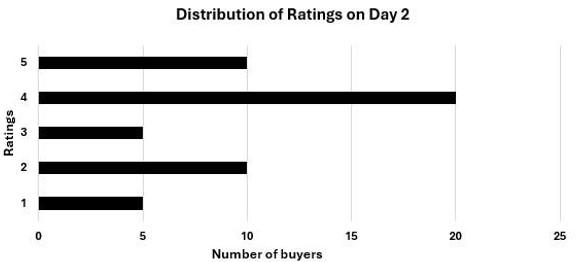
An online e-commerce firm receives daily integer product ratings from 1 through 5 given by buyers. The daily average is the average of the ratings given on that day. The cumulative average is the average of all ratings given on or before that day. The rating system began on Day 1, and the cumulative averages were 3 and 3.1 at the end of Day 1 and Day 2, respectively. The distribution of ratings on Day 2 is given in the figure below.
The following information is known about ratings on Day 3.
1. 100 buyers gave product ratings on Day 3.
2. The modes of the product ratings were 4 and 5.
3. The numbers of buyers giving each product rating are non-zero multiples of 10.
4. The same number of buyers gave product ratings of 1 and 2, and that number is half the number of buyers who gave a rating of 3.
Passage 2 · CAT2024Slot2_DILR2 · 5 Questions
Eight gymnastics players numbered 1 through 8 underwent a training camp where they were coached by three coaches - Xena, Yuki, and Zara. Each coach trained at least two players. Yuki trained only even numbered players, while Zara trained only odd numbered players. After the camp, the coaches evaluated the players and gave integer ratings to the respective players trained by them on a scale of 1 to 7, with 1 being the lowest rating and 7 the highest.
The following additional information is known.
1. Xena trained more players than Yuki.
2. Player-1 and Player-4 were trained by the same coach, while the coaches who trained Player-2, Player-3 and Player-5 were all different.
3. Player-5 and Player-7 were trained by the same coach and got the same rating. All other players got a unique rating.
4. The average of the ratings of all the players was 4.
5. Player-2 got the highest rating.
6. The average of the ratings of the players trained by Yuki was twice that of the players trained by Xena and two more than that of the players trained by Zara.
7. Player-4's rating was double of Player-8's and less than Player-5's.
Passage 3 · CAT2024Slot2_DILR3 · 4 Questions
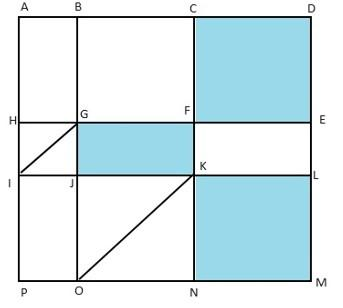
The above is a schematic diagram of walkways (indicated by all the straight-lines) and lakes (3 of them, each in the shape of rectangles – shaded in the diagram) of a gated area. Different points on the walkway are indicated by letters (A through P) with distances being OP = 150 m, ON = MN = 300m, ML = 400m, EL = 200m, DE = 400m.
The following additional information about the facilities in the area is known.
1. The only entry/exit point is at C.
2. There are many residences within the gated area; all of them are located on the path AH and ML with four of them being at A, H, M, and L.
3. The post office is located at P and the bank is located at B.
Passage 4 · CAT2024Slot2_DILR4 · 4 Questions
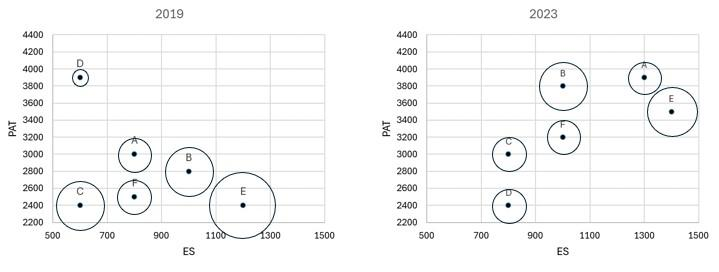
The two plots below give the following information about six firms A, B, C, D, E, and F for 2019 and 2023.
PAT: The firm’s profits after taxes in Rs. crores,
ES: The firm’s employee strength, that is the number of employees in the firm, and
PRD: The percentage of the firm’s PAT that they spend on Research and Development (R&D).
In the plots, the horizontal and vertical coordinates of point representing each firm gives their ES and PAT values respectively. The PRD values of each firm are proportional to the areas around the points representing each firm. The areas are comparable between the two plots, i.e., equal areas in the two plots represent the same PRD values for the two years.
Passage 5 · CAT2024Slot2_DILR5 · 5 Questions
The numbers 1, 2, 3, 4, 5, 6, 7, 8, 9, and 10 are placed in ten slots of the following grid based on the conditions below.
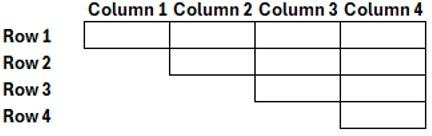
1. Numbers in any row appear in an increasing order from left to right.
2. Numbers in any column appear in a decreasing order from top to bottom.
3. 1 is placed either in the same row or in the same column as 10.
4. Neither 2 nor 3 is placed in the same row or in the same column as 10.
5. Neither 7 nor 8 is placed in the same row or in the same column as 9.
6. 4 and 6 are placed in the same row.
I. 10 is placed in a slot in Row 1.
II. 1 is placed in a slot in Row 4.
I. 2 is placed in a slot in Column 2.
II. 3 is placed in a slot in Column 3.
About CAT 2024 Slot 2 DILR
The DILR section of CAT 2024 Slot 2 was conducted on November 30, 2024, the last Sunday of November — consistent with IIM's scheduling across all recent years. The section contains 24 questions to be answered in 40 minutes, carrying 72 marks in total. There is no sectional time limit within the overall exam, but students choosing to switch sections mid-paper lose the ability to return — making pacing within DILR critical.
Passage Topics in CAT 2024 Slot 2 DILR
CAT 2024 Slot 2 DILR featured four reading comprehension passages and a standalone Verbal Ability block. The RC passages spanned complexity theory and global systems, the aesthetics of electronic music, the economics of income inequality, and the legal history of criminal responsibility — a typical CAT spread across the sciences, humanities, and social sciences. The VA section included Para Jumbles, Para Summary, and Odd Sentence Out questions, consistent with the pattern since CAT 2019.
CAT 2024 DILR Marking Scheme
- Correct answer (MCQ): +3 marks
- Wrong answer (MCQ): −1 mark
- Unattempted (MCQ): 0 marks
- TITA questions (if any): +3 correct, no negative marking
How to Use This Question Paper
Click any answer option to immediately check your answer. The correct option is highlighted in green; if you selected the wrong option, it is shown in red and the correct answer is revealed. A detailed explanation appears below each question after you answer it, along with statistics showing what percentage of students answered correctly in the actual exam.
The question navigator at the top of the page updates in real time — green bubbles indicate correct answers and red indicate wrong. Use this to spot weak areas at a glance. To practice under timed conditions, use the Take Full Mock button to attempt the complete CAT 2024 Slot 2 paper with a live timer and percentile benchmarking.
Tips for CAT DILR Preparation
Reading Comprehension accounts for roughly two-thirds of the DILR section. The passages in CAT are dense and argumentative — they reward close reading of the author's position rather than skimming for facts. Practising on past papers is the most reliable way to calibrate your reading speed, improve inference accuracy, and recognise the types of questions IIM setters favour. Use the answer statistics on this page to benchmark yourself; questions where more than 50% of test-takers answered correctly are ones you should aim to get right every time.