CAT 2025 Slot 3 DILR Question Paper with Solutions
Passage 1 · CAT2025Slot3_DILR1 · 1 Questions
Seven children, Aarav, Bina, Chirag, Diya, Eshan, Farhan, and Gaurav, are sitting in a circle facing inside (not necessarily in the same order) and playing a game of ‘Passing the Buck’.
The game is played over 10 rounds. In each round, the child holding the Buck must pass it directly to a child sitting in one of the following positions:
• Immediately to the left; • Immediate to the right; • Second to the left; or • Second to the right.
The game starts with Bina passing the Buck and ends with Chirag receiving the Buck. The table below provides some information about the pass types and the child receiving the Buck. Some information is missing and labelled as ‘?’.
| Round | Pass Type | Received by |
|---|---|---|
| 1 | Immediately to the left | Aarav |
| 2 | Second to the right | ? |
| 3 | Immediately to the right | Diya |
| 4 | ? | ? |
| 5 | ? | Aarav |
| 6 | Second to the left | ? |
| 7 | Immediately to the left | Gaurav |
| 8 | Immediately to the left | ? |
| 9 | ? | Farhan |
| 10 | ? | Chirag |
Passage 2 · CAT2024Slot1_DILR1 · 1 Questions
The chart below shows the price data for seven shares – A, B, C, D, E, F, and G as a candlestick plot for a particular day. The vertical axis shows the price of the share in rupees. A share whose closing price (price at the end of the day) is more than its opening price (price at the start of the day) is called a bullish share; otherwise, it is called a bearish share. All bullish and bearish shares are shown in green and red colour respectively

Passage 3 · CAT2025Slot3_DILR1 · 1 Questions
Seven children, Aarav, Bina, Chirag, Diya, Eshan, Farhan, and Gaurav, are sitting in a circle facing inside (not necessarily in the same order) and playing a game of ‘Passing the Buck’.
The game is played over 10 rounds. In each round, the child holding the Buck must pass it directly to a child sitting in one of the following positions:
• Immediately to the left; • Immediate to the right; • Second to the left; or • Second to the right.
The game starts with Bina passing the Buck and ends with Chirag receiving the Buck. The table below provides some information about the pass types and the child receiving the Buck. Some information is missing and labelled as ‘?’.
| Round | Pass Type | Received by |
|---|---|---|
| 1 | Immediately to the left | Aarav |
| 2 | Second to the right | ? |
| 3 | Immediately to the right | Diya |
| 4 | ? | ? |
| 5 | ? | Aarav |
| 6 | Second to the left | ? |
| 7 | Immediately to the left | Gaurav |
| 8 | Immediately to the left | ? |
| 9 | ? | Farhan |
| 10 | ? | Chirag |
Passage 4 · CAT2024Slot1_DILR1 · 1 Questions
The chart below shows the price data for seven shares – A, B, C, D, E, F, and G as a candlestick plot for a particular day. The vertical axis shows the price of the share in rupees. A share whose closing price (price at the end of the day) is more than its opening price (price at the start of the day) is called a bullish share; otherwise, it is called a bearish share. All bullish and bearish shares are shown in green and red colour respectively

Passage 5 · CAT2025Slot3_DILR1 · 1 Questions
Seven children, Aarav, Bina, Chirag, Diya, Eshan, Farhan, and Gaurav, are sitting in a circle facing inside (not necessarily in the same order) and playing a game of ‘Passing the Buck’.
The game is played over 10 rounds. In each round, the child holding the Buck must pass it directly to a child sitting in one of the following positions:
• Immediately to the left; • Immediate to the right; • Second to the left; or • Second to the right.
The game starts with Bina passing the Buck and ends with Chirag receiving the Buck. The table below provides some information about the pass types and the child receiving the Buck. Some information is missing and labelled as ‘?’.
| Round | Pass Type | Received by |
|---|---|---|
| 1 | Immediately to the left | Aarav |
| 2 | Second to the right | ? |
| 3 | Immediately to the right | Diya |
| 4 | ? | ? |
| 5 | ? | Aarav |
| 6 | Second to the left | ? |
| 7 | Immediately to the left | Gaurav |
| 8 | Immediately to the left | ? |
| 9 | ? | Farhan |
| 10 | ? | Chirag |
Passage 6 · CAT2024Slot1_DILR1 · 1 Questions
The chart below shows the price data for seven shares – A, B, C, D, E, F, and G as a candlestick plot for a particular day. The vertical axis shows the price of the share in rupees. A share whose closing price (price at the end of the day) is more than its opening price (price at the start of the day) is called a bullish share; otherwise, it is called a bearish share. All bullish and bearish shares are shown in green and red colour respectively

Passage 7 · CAT2025Slot3_DILR1 · 1 Questions
Seven children, Aarav, Bina, Chirag, Diya, Eshan, Farhan, and Gaurav, are sitting in a circle facing inside (not necessarily in the same order) and playing a game of ‘Passing the Buck’.
The game is played over 10 rounds. In each round, the child holding the Buck must pass it directly to a child sitting in one of the following positions:
• Immediately to the left; • Immediate to the right; • Second to the left; or • Second to the right.
The game starts with Bina passing the Buck and ends with Chirag receiving the Buck. The table below provides some information about the pass types and the child receiving the Buck. Some information is missing and labelled as ‘?’.
| Round | Pass Type | Received by |
|---|---|---|
| 1 | Immediately to the left | Aarav |
| 2 | Second to the right | ? |
| 3 | Immediately to the right | Diya |
| 4 | ? | ? |
| 5 | ? | Aarav |
| 6 | Second to the left | ? |
| 7 | Immediately to the left | Gaurav |
| 8 | Immediately to the left | ? |
| 9 | ? | Farhan |
| 10 | ? | Chirag |
Passage 8 · CAT2024Slot1_DILR1 · 1 Questions
The chart below shows the price data for seven shares – A, B, C, D, E, F, and G as a candlestick plot for a particular day. The vertical axis shows the price of the share in rupees. A share whose closing price (price at the end of the day) is more than its opening price (price at the start of the day) is called a bullish share; otherwise, it is called a bearish share. All bullish and bearish shares are shown in green and red colour respectively

Passage 9 · CAT2025Slot3_DILR2 · 1 Questions
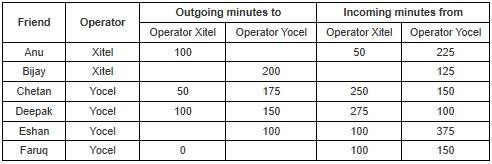
Anu, Bijay, Chetan, Deepak, Eshan, and Faruq are six friends. Each of them uses a mobile number from exactly one of the two mobile operators - Xitel and Yocel. During the last month, the six friends made several calls to each other. Each call was made by one of these six friends to another. The table below summarizes the number of minutes of calls that each of the six made to (outgoing minutes) and received from (incoming minutes) these friends, grouped by the operators. Some of the entries are missing.

It is known that the duration of calls from Faruq to Eshan was 200 minutes. Also, there were no calls from: i. Bijay to Eshan, ii. Chetan to Anu and Chetan to Deepak, iii. Deepak to Bijay and Deepak to Faruq, iv. Eshan to Chetan and Eshan to Deepak.
Passage 10 · CAT2024Slot1_DILR2 · 1 Questions
The game of QUIET is played between two teams. Six teams, numbered 1, 2, 3, 4, 5, and 6, play in a QUIET tournament. These teams are divided equally into two groups. In the tournament, each team plays every other team in the same group only once, and each team in the other group exactly twice. The tournament has several rounds, each of which consists of a few games. Every team plays exactly one game in each round.
The following additional facts are known about the schedule of games in the tournament.
1. Each team played against a team from the other group in Round 8.
2. In Round 4 and Round 7, the match-ups, that is the pair of teams playing against each other, were identical. In Round 5 and Round 8, the match-ups were identical.
3. Team 4 played Team 6 in both Round 1 and Round 2.
4. Team 1 played Team 5 ONLY once and that was in Round 2.
5. Team 3 played Team 4 in Round 3. Team 1 played Team 6 in Round 6.
6. In Round 8, Team 3 played Team 6, while Team 2 played Team 5.
Passage 11 · CAT2025Slot3_DILR2 · 1 Questions
Anu, Bijay, Chetan, Deepak, Eshan, and Faruq are six friends. Each of them uses a mobile number from exactly one of the two mobile operators - Xitel and Yocel. During the last month, the six friends made several calls to each other. Each call was made by one of these six friends to another. The table below summarizes the number of minutes of calls that each of the six made to (outgoing minutes) and received from (incoming minutes) these friends, grouped by the operators. Some of the entries are missing.

It is known that the duration of calls from Faruq to Eshan was 200 minutes. Also, there were no calls from: i. Bijay to Eshan, ii. Chetan to Anu and Chetan to Deepak, iii. Deepak to Bijay and Deepak to Faruq, iv. Eshan to Chetan and Eshan to Deepak.
Passage 12 · CAT2024Slot1_DILR2 · 1 Questions
The game of QUIET is played between two teams. Six teams, numbered 1, 2, 3, 4, 5, and 6, play in a QUIET tournament. These teams are divided equally into two groups. In the tournament, each team plays every other team in the same group only once, and each team in the other group exactly twice. The tournament has several rounds, each of which consists of a few games. Every team plays exactly one game in each round.
The following additional facts are known about the schedule of games in the tournament.
1. Each team played against a team from the other group in Round 8.
2. In Round 4 and Round 7, the match-ups, that is the pair of teams playing against each other, were identical. In Round 5 and Round 8, the match-ups were identical.
3. Team 4 played Team 6 in both Round 1 and Round 2.
4. Team 1 played Team 5 ONLY once and that was in Round 2.
5. Team 3 played Team 4 in Round 3. Team 1 played Team 6 in Round 6.
6. In Round 8, Team 3 played Team 6, while Team 2 played Team 5.
Passage 13 · CAT2025Slot3_DILR2 · 1 Questions
Anu, Bijay, Chetan, Deepak, Eshan, and Faruq are six friends. Each of them uses a mobile number from exactly one of the two mobile operators - Xitel and Yocel. During the last month, the six friends made several calls to each other. Each call was made by one of these six friends to another. The table below summarizes the number of minutes of calls that each of the six made to (outgoing minutes) and received from (incoming minutes) these friends, grouped by the operators. Some of the entries are missing.

It is known that the duration of calls from Faruq to Eshan was 200 minutes. Also, there were no calls from: i. Bijay to Eshan, ii. Chetan to Anu and Chetan to Deepak, iii. Deepak to Bijay and Deepak to Faruq, iv. Eshan to Chetan and Eshan to Deepak.
Passage 14 · CAT2024Slot1_DILR2 · 1 Questions
The game of QUIET is played between two teams. Six teams, numbered 1, 2, 3, 4, 5, and 6, play in a QUIET tournament. These teams are divided equally into two groups. In the tournament, each team plays every other team in the same group only once, and each team in the other group exactly twice. The tournament has several rounds, each of which consists of a few games. Every team plays exactly one game in each round.
The following additional facts are known about the schedule of games in the tournament.
1. Each team played against a team from the other group in Round 8.
2. In Round 4 and Round 7, the match-ups, that is the pair of teams playing against each other, were identical. In Round 5 and Round 8, the match-ups were identical.
3. Team 4 played Team 6 in both Round 1 and Round 2.
4. Team 1 played Team 5 ONLY once and that was in Round 2.
5. Team 3 played Team 4 in Round 3. Team 1 played Team 6 in Round 6.
6. In Round 8, Team 3 played Team 6, while Team 2 played Team 5.
Passage 15 · CAT2025Slot3_DILR2 · 1 Questions
Anu, Bijay, Chetan, Deepak, Eshan, and Faruq are six friends. Each of them uses a mobile number from exactly one of the two mobile operators - Xitel and Yocel. During the last month, the six friends made several calls to each other. Each call was made by one of these six friends to another. The table below summarizes the number of minutes of calls that each of the six made to (outgoing minutes) and received from (incoming minutes) these friends, grouped by the operators. Some of the entries are missing.

It is known that the duration of calls from Faruq to Eshan was 200 minutes. Also, there were no calls from: i. Bijay to Eshan, ii. Chetan to Anu and Chetan to Deepak, iii. Deepak to Bijay and Deepak to Faruq, iv. Eshan to Chetan and Eshan to Deepak.
Passage 16 · CAT2024Slot1_DILR2 · 1 Questions
The game of QUIET is played between two teams. Six teams, numbered 1, 2, 3, 4, 5, and 6, play in a QUIET tournament. These teams are divided equally into two groups. In the tournament, each team plays every other team in the same group only once, and each team in the other group exactly twice. The tournament has several rounds, each of which consists of a few games. Every team plays exactly one game in each round.
The following additional facts are known about the schedule of games in the tournament.
1. Each team played against a team from the other group in Round 8.
2. In Round 4 and Round 7, the match-ups, that is the pair of teams playing against each other, were identical. In Round 5 and Round 8, the match-ups were identical.
3. Team 4 played Team 6 in both Round 1 and Round 2.
4. Team 1 played Team 5 ONLY once and that was in Round 2.
5. Team 3 played Team 4 in Round 3. Team 1 played Team 6 in Round 6.
6. In Round 8, Team 3 played Team 6, while Team 2 played Team 5.
Passage 17 · CAT2025Slot3_DILR3 · 1 Questions
Aurevia, Brelosia, Cyrenia and Zerathania are four countries with their currencies being Aurels, Brins, Crowns, and Zentars, respectively. The currencies have different exchange values. Crown’s currency exchange rate with Zentars is , i.e., 1 Crown is worth 0.5 Zentars.
Three travelers, Jano, Kira, and Lian set out from Zerathania visiting exactly two of the countries. Each country is visited by exactly two travelers. Each traveler has a unique Flight Cost, which represents the total cost of airfare in traveling to both the countries and back to Zerathania. The Flight Cost of Jano was 4000 Zentars, while that of the other two travelers were 5000 and 6000 Zentars, not necessarily in that order. When visiting a country, a traveler spent either 1000, 2000 or 3000 in the country’s local currency. Each traveler had different spends (in the country’s local currency) in the two countries he/she visited. Across all the visits, there were exactly two spends of 1000 and exactly one spend of 3000 (in the country’s local currency).
The total “Travel Cost” for a traveler is the sum of his/her Flight Cost and the money spent in the countries visited.
The citizens of the four countries with knowledge of these travels made a few observations, with spends measured in their respective local currencies: i. Aurevia citizen: Jano and Kira visited our country, and their Travel Costs were 3500 and 8000, respectively. ii. Brelosia citizen: Kira and Lian visited our country, spending 2000 and 3000, respectively. Kira’s Travel Cost was 4000. iii. Cyrenia citizen: Lian visited our country and her Travel Cost was 36000.
Passage 18 · CAT2024Slot1_DILR2 · 1 Questions
The game of QUIET is played between two teams. Six teams, numbered 1, 2, 3, 4, 5, and 6, play in a QUIET tournament. These teams are divided equally into two groups. In the tournament, each team plays every other team in the same group only once, and each team in the other group exactly twice. The tournament has several rounds, each of which consists of a few games. Every team plays exactly one game in each round.
The following additional facts are known about the schedule of games in the tournament.
1. Each team played against a team from the other group in Round 8.
2. In Round 4 and Round 7, the match-ups, that is the pair of teams playing against each other, were identical. In Round 5 and Round 8, the match-ups were identical.
3. Team 4 played Team 6 in both Round 1 and Round 2.
4. Team 1 played Team 5 ONLY once and that was in Round 2.
5. Team 3 played Team 4 in Round 3. Team 1 played Team 6 in Round 6.
6. In Round 8, Team 3 played Team 6, while Team 2 played Team 5.
Passage 19 · CAT2025Slot3_DILR3 · 1 Questions
Aurevia, Brelosia, Cyrenia and Zerathania are four countries with their currencies being Aurels, Brins, Crowns, and Zentars, respectively. The currencies have different exchange values. Crown’s currency exchange rate with Zentars is , i.e., 1 Crown is worth 0.5 Zentars.
Three travelers, Jano, Kira, and Lian set out from Zerathania visiting exactly two of the countries. Each country is visited by exactly two travelers. Each traveler has a unique Flight Cost, which represents the total cost of airfare in traveling to both the countries and back to Zerathania. The Flight Cost of Jano was 4000 Zentars, while that of the other two travelers were 5000 and 6000 Zentars, not necessarily in that order. When visiting a country, a traveler spent either 1000, 2000 or 3000 in the country’s local currency. Each traveler had different spends (in the country’s local currency) in the two countries he/she visited. Across all the visits, there were exactly two spends of 1000 and exactly one spend of 3000 (in the country’s local currency).
The total “Travel Cost” for a traveler is the sum of his/her Flight Cost and the money spent in the countries visited.
The citizens of the four countries with knowledge of these travels made a few observations, with spends measured in their respective local currencies: i. Aurevia citizen: Jano and Kira visited our country, and their Travel Costs were 3500 and 8000, respectively. ii. Brelosia citizen: Kira and Lian visited our country, spending 2000 and 3000, respectively. Kira’s Travel Cost was 4000. iii. Cyrenia citizen: Lian visited our country and her Travel Cost was 36000.
Passage 20 · CAT2024Slot1_DILR3 · 1 Questions
Two students, Amiya and Ramya are the only candidates in an election for the position of class representative. Students will vote based on the intensity level of Amiya’s and Ramya’s campaigns and the type of campaigns they run. Each campaign is said to have a level of 1 if it is a staid campaign and a level of 2 if it is a vigorous campaign. Campaigns can be of two types, they can either focus on issues, or on attacking the other candidate.
If Amiya and Ramya both run campaigns focusing on issues, then
• The percentage of students voting in the election will be 20 times the sum of the levels of campaigning of the two students. For example, if Amiya and Ramya both run vigorous campaigns, then , that is, of the students will vote in the election.
• Among voting students, the percentage of votes for each candidate will be proportional to the levels of their campaigns. For example, if Amiya runs a staid (i.e., level 1) campaign while Ramya runs a vigorous (i.e., level 2) campaign, then Amiya will receive of the votes cast, and Ramya will receive the other .
The above-mentioned percentages change as follows if at least one of them runs a campaign attacking their opponent.
• If Amiya runs a campaign attacking Ramya and Ramya runs a campaign focusing on issues, then 10% of the students who would have otherwise voted for Amiya will vote for Ramya, and another 10% who would have otherwise voted for Amiya, will not vote at all.
• If Ramya runs a campaign attacking Amiya and Amiya runs a campaign focusing on issues, then 20% of the students who would have otherwise voted for Ramya will vote for Amiya, and another 5% who would have otherwise voted for Ramya, will not vote at all.
• If both run campaigns attacking each other, then 10% of the students who would have otherwise voted for them had they run campaigns focusing on issues, will not vote at all.
Passage 21 · CAT2025Slot3_DILR3 · 1 Questions
Aurevia, Brelosia, Cyrenia and Zerathania are four countries with their currencies being Aurels, Brins, Crowns, and Zentars, respectively. The currencies have different exchange values. Crown’s currency exchange rate with Zentars is , i.e., 1 Crown is worth 0.5 Zentars.
Three travelers, Jano, Kira, and Lian set out from Zerathania visiting exactly two of the countries. Each country is visited by exactly two travelers. Each traveler has a unique Flight Cost, which represents the total cost of airfare in traveling to both the countries and back to Zerathania. The Flight Cost of Jano was 4000 Zentars, while that of the other two travelers were 5000 and 6000 Zentars, not necessarily in that order. When visiting a country, a traveler spent either 1000, 2000 or 3000 in the country’s local currency. Each traveler had different spends (in the country’s local currency) in the two countries he/she visited. Across all the visits, there were exactly two spends of 1000 and exactly one spend of 3000 (in the country’s local currency).
The total “Travel Cost” for a traveler is the sum of his/her Flight Cost and the money spent in the countries visited.
The citizens of the four countries with knowledge of these travels made a few observations, with spends measured in their respective local currencies: i. Aurevia citizen: Jano and Kira visited our country, and their Travel Costs were 3500 and 8000, respectively. ii. Brelosia citizen: Kira and Lian visited our country, spending 2000 and 3000, respectively. Kira’s Travel Cost was 4000. iii. Cyrenia citizen: Lian visited our country and her Travel Cost was 36000.
Passage 22 · CAT2024Slot1_DILR3 · 1 Questions
Two students, Amiya and Ramya are the only candidates in an election for the position of class representative. Students will vote based on the intensity level of Amiya’s and Ramya’s campaigns and the type of campaigns they run. Each campaign is said to have a level of 1 if it is a staid campaign and a level of 2 if it is a vigorous campaign. Campaigns can be of two types, they can either focus on issues, or on attacking the other candidate.
If Amiya and Ramya both run campaigns focusing on issues, then
• The percentage of students voting in the election will be 20 times the sum of the levels of campaigning of the two students. For example, if Amiya and Ramya both run vigorous campaigns, then , that is, of the students will vote in the election.
• Among voting students, the percentage of votes for each candidate will be proportional to the levels of their campaigns. For example, if Amiya runs a staid (i.e., level 1) campaign while Ramya runs a vigorous (i.e., level 2) campaign, then Amiya will receive of the votes cast, and Ramya will receive the other .
The above-mentioned percentages change as follows if at least one of them runs a campaign attacking their opponent.
• If Amiya runs a campaign attacking Ramya and Ramya runs a campaign focusing on issues, then 10% of the students who would have otherwise voted for Amiya will vote for Ramya, and another 10% who would have otherwise voted for Amiya, will not vote at all.
• If Ramya runs a campaign attacking Amiya and Amiya runs a campaign focusing on issues, then 20% of the students who would have otherwise voted for Ramya will vote for Amiya, and another 5% who would have otherwise voted for Ramya, will not vote at all.
• If both run campaigns attacking each other, then 10% of the students who would have otherwise voted for them had they run campaigns focusing on issues, will not vote at all.
Passage 23 · CAT2025Slot3_DILR3 · 1 Questions
Aurevia, Brelosia, Cyrenia and Zerathania are four countries with their currencies being Aurels, Brins, Crowns, and Zentars, respectively. The currencies have different exchange values. Crown’s currency exchange rate with Zentars is , i.e., 1 Crown is worth 0.5 Zentars.
Three travelers, Jano, Kira, and Lian set out from Zerathania visiting exactly two of the countries. Each country is visited by exactly two travelers. Each traveler has a unique Flight Cost, which represents the total cost of airfare in traveling to both the countries and back to Zerathania. The Flight Cost of Jano was 4000 Zentars, while that of the other two travelers were 5000 and 6000 Zentars, not necessarily in that order. When visiting a country, a traveler spent either 1000, 2000 or 3000 in the country’s local currency. Each traveler had different spends (in the country’s local currency) in the two countries he/she visited. Across all the visits, there were exactly two spends of 1000 and exactly one spend of 3000 (in the country’s local currency).
The total “Travel Cost” for a traveler is the sum of his/her Flight Cost and the money spent in the countries visited.
The citizens of the four countries with knowledge of these travels made a few observations, with spends measured in their respective local currencies: i. Aurevia citizen: Jano and Kira visited our country, and their Travel Costs were 3500 and 8000, respectively. ii. Brelosia citizen: Kira and Lian visited our country, spending 2000 and 3000, respectively. Kira’s Travel Cost was 4000. iii. Cyrenia citizen: Lian visited our country and her Travel Cost was 36000.
Passage 24 · CAT2024Slot1_DILR3 · 1 Questions
Two students, Amiya and Ramya are the only candidates in an election for the position of class representative. Students will vote based on the intensity level of Amiya’s and Ramya’s campaigns and the type of campaigns they run. Each campaign is said to have a level of 1 if it is a staid campaign and a level of 2 if it is a vigorous campaign. Campaigns can be of two types, they can either focus on issues, or on attacking the other candidate.
If Amiya and Ramya both run campaigns focusing on issues, then
• The percentage of students voting in the election will be 20 times the sum of the levels of campaigning of the two students. For example, if Amiya and Ramya both run vigorous campaigns, then , that is, of the students will vote in the election.
• Among voting students, the percentage of votes for each candidate will be proportional to the levels of their campaigns. For example, if Amiya runs a staid (i.e., level 1) campaign while Ramya runs a vigorous (i.e., level 2) campaign, then Amiya will receive of the votes cast, and Ramya will receive the other .
The above-mentioned percentages change as follows if at least one of them runs a campaign attacking their opponent.
• If Amiya runs a campaign attacking Ramya and Ramya runs a campaign focusing on issues, then 10% of the students who would have otherwise voted for Amiya will vote for Ramya, and another 10% who would have otherwise voted for Amiya, will not vote at all.
• If Ramya runs a campaign attacking Amiya and Amiya runs a campaign focusing on issues, then 20% of the students who would have otherwise voted for Ramya will vote for Amiya, and another 5% who would have otherwise voted for Ramya, will not vote at all.
• If both run campaigns attacking each other, then 10% of the students who would have otherwise voted for them had they run campaigns focusing on issues, will not vote at all.
Passage 25 · CAT2025Slot3_DILR3 · 1 Questions
Aurevia, Brelosia, Cyrenia and Zerathania are four countries with their currencies being Aurels, Brins, Crowns, and Zentars, respectively. The currencies have different exchange values. Crown’s currency exchange rate with Zentars is , i.e., 1 Crown is worth 0.5 Zentars.
Three travelers, Jano, Kira, and Lian set out from Zerathania visiting exactly two of the countries. Each country is visited by exactly two travelers. Each traveler has a unique Flight Cost, which represents the total cost of airfare in traveling to both the countries and back to Zerathania. The Flight Cost of Jano was 4000 Zentars, while that of the other two travelers were 5000 and 6000 Zentars, not necessarily in that order. When visiting a country, a traveler spent either 1000, 2000 or 3000 in the country’s local currency. Each traveler had different spends (in the country’s local currency) in the two countries he/she visited. Across all the visits, there were exactly two spends of 1000 and exactly one spend of 3000 (in the country’s local currency).
The total “Travel Cost” for a traveler is the sum of his/her Flight Cost and the money spent in the countries visited.
The citizens of the four countries with knowledge of these travels made a few observations, with spends measured in their respective local currencies: i. Aurevia citizen: Jano and Kira visited our country, and their Travel Costs were 3500 and 8000, respectively. ii. Brelosia citizen: Kira and Lian visited our country, spending 2000 and 3000, respectively. Kira’s Travel Cost was 4000. iii. Cyrenia citizen: Lian visited our country and her Travel Cost was 36000.
Passage 26 · CAT2024Slot1_DILR3 · 1 Questions
Two students, Amiya and Ramya are the only candidates in an election for the position of class representative. Students will vote based on the intensity level of Amiya’s and Ramya’s campaigns and the type of campaigns they run. Each campaign is said to have a level of 1 if it is a staid campaign and a level of 2 if it is a vigorous campaign. Campaigns can be of two types, they can either focus on issues, or on attacking the other candidate.
If Amiya and Ramya both run campaigns focusing on issues, then
• The percentage of students voting in the election will be 20 times the sum of the levels of campaigning of the two students. For example, if Amiya and Ramya both run vigorous campaigns, then , that is, of the students will vote in the election.
• Among voting students, the percentage of votes for each candidate will be proportional to the levels of their campaigns. For example, if Amiya runs a staid (i.e., level 1) campaign while Ramya runs a vigorous (i.e., level 2) campaign, then Amiya will receive of the votes cast, and Ramya will receive the other .
The above-mentioned percentages change as follows if at least one of them runs a campaign attacking their opponent.
• If Amiya runs a campaign attacking Ramya and Ramya runs a campaign focusing on issues, then 10% of the students who would have otherwise voted for Amiya will vote for Ramya, and another 10% who would have otherwise voted for Amiya, will not vote at all.
• If Ramya runs a campaign attacking Amiya and Amiya runs a campaign focusing on issues, then 20% of the students who would have otherwise voted for Ramya will vote for Amiya, and another 5% who would have otherwise voted for Ramya, will not vote at all.
• If both run campaigns attacking each other, then 10% of the students who would have otherwise voted for them had they run campaigns focusing on issues, will not vote at all.
Passage 27 · CAT2025Slot3_DILR4 · 1 Questions
Three countries — Pumpland (P), Xiland (X) and Cheeseland (C) — trade among themselves and with the (other countries in) Rest of World (ROW). All trade volumes are given in IC (international currency). The following terminology is used: • Trade balance = Exports – Imports • Total trade = Exports + Imports • Normalized trade balance = , expressed in percentage terms
The following information is known. 1. The normalized trade balances of P, X and C are 0%, 10%, and –20%, respectively. 2. 40% of exports of X are to P. 22% of imports of P are from X. 3. 90% of exports of C are to P; 4% are to ROW. 4. 12% of exports of ROW are to X, 40% are to P. 5. The export volumes of P, in IC, to X and C are 600 and 1200, respectively. P is the only country that exports to C.
Passage 28 · CAT2024Slot1_DILR3 · 1 Questions
Two students, Amiya and Ramya are the only candidates in an election for the position of class representative. Students will vote based on the intensity level of Amiya’s and Ramya’s campaigns and the type of campaigns they run. Each campaign is said to have a level of 1 if it is a staid campaign and a level of 2 if it is a vigorous campaign. Campaigns can be of two types, they can either focus on issues, or on attacking the other candidate.
If Amiya and Ramya both run campaigns focusing on issues, then
• The percentage of students voting in the election will be 20 times the sum of the levels of campaigning of the two students. For example, if Amiya and Ramya both run vigorous campaigns, then , that is, of the students will vote in the election.
• Among voting students, the percentage of votes for each candidate will be proportional to the levels of their campaigns. For example, if Amiya runs a staid (i.e., level 1) campaign while Ramya runs a vigorous (i.e., level 2) campaign, then Amiya will receive of the votes cast, and Ramya will receive the other .
The above-mentioned percentages change as follows if at least one of them runs a campaign attacking their opponent.
• If Amiya runs a campaign attacking Ramya and Ramya runs a campaign focusing on issues, then 10% of the students who would have otherwise voted for Amiya will vote for Ramya, and another 10% who would have otherwise voted for Amiya, will not vote at all.
• If Ramya runs a campaign attacking Amiya and Amiya runs a campaign focusing on issues, then 20% of the students who would have otherwise voted for Ramya will vote for Amiya, and another 5% who would have otherwise voted for Ramya, will not vote at all.
• If both run campaigns attacking each other, then 10% of the students who would have otherwise voted for them had they run campaigns focusing on issues, will not vote at all.
Passage 29 · CAT2025Slot3_DILR4 · 1 Questions
Three countries — Pumpland (P), Xiland (X) and Cheeseland (C) — trade among themselves and with the (other countries in) Rest of World (ROW). All trade volumes are given in IC (international currency). The following terminology is used: • Trade balance = Exports – Imports • Total trade = Exports + Imports • Normalized trade balance = , expressed in percentage terms
The following information is known. 1. The normalized trade balances of P, X and C are 0%, 10%, and –20%, respectively. 2. 40% of exports of X are to P. 22% of imports of P are from X. 3. 90% of exports of C are to P; 4% are to ROW. 4. 12% of exports of ROW are to X, 40% are to P. 5. The export volumes of P, in IC, to X and C are 600 and 1200, respectively. P is the only country that exports to C.
Passage 30 · CAT2024Slot1_DILR4 · 1 Questions
The chart below provides complete information about the number of countries visited by Dheeraj, Samantha and Nitesh, in Asia, Europe and the rest of the world (ROW).

The following additional facts are known about the countries visited by them.
1. 32 countries were visited by at least one of them.
2. USA (in ROW) is the only country that was visited by all three of them.
3. China (in Asia) is the only country that was visited by both Dheeraj and Nitesh, but not by Samantha.
4. France (in Europe) is the only country outside Asia, which was visited by both Dheeraj and Samantha, but not by Nitesh.
5. Half of the countries visited by both Samantha and Nitesh are in Europe.
Passage 31 · CAT2025Slot3_DILR4 · 1 Questions
Three countries — Pumpland (P), Xiland (X) and Cheeseland (C) — trade among themselves and with the (other countries in) Rest of World (ROW). All trade volumes are given in IC (international currency). The following terminology is used: • Trade balance = Exports – Imports • Total trade = Exports + Imports • Normalized trade balance = , expressed in percentage terms
The following information is known. 1. The normalized trade balances of P, X and C are 0%, 10%, and –20%, respectively. 2. 40% of exports of X are to P. 22% of imports of P are from X. 3. 90% of exports of C are to P; 4% are to ROW. 4. 12% of exports of ROW are to X, 40% are to P. 5. The export volumes of P, in IC, to X and C are 600 and 1200, respectively. P is the only country that exports to C.
Passage 32 · CAT2024Slot1_DILR4 · 1 Questions
The chart below provides complete information about the number of countries visited by Dheeraj, Samantha and Nitesh, in Asia, Europe and the rest of the world (ROW).

The following additional facts are known about the countries visited by them.
1. 32 countries were visited by at least one of them.
2. USA (in ROW) is the only country that was visited by all three of them.
3. China (in Asia) is the only country that was visited by both Dheeraj and Nitesh, but not by Samantha.
4. France (in Europe) is the only country outside Asia, which was visited by both Dheeraj and Samantha, but not by Nitesh.
5. Half of the countries visited by both Samantha and Nitesh are in Europe.
Passage 33 · CAT2025Slot3_DILR4 · 1 Questions
Three countries — Pumpland (P), Xiland (X) and Cheeseland (C) — trade among themselves and with the (other countries in) Rest of World (ROW). All trade volumes are given in IC (international currency). The following terminology is used: • Trade balance = Exports – Imports • Total trade = Exports + Imports • Normalized trade balance = , expressed in percentage terms
The following information is known. 1. The normalized trade balances of P, X and C are 0%, 10%, and –20%, respectively. 2. 40% of exports of X are to P. 22% of imports of P are from X. 3. 90% of exports of C are to P; 4% are to ROW. 4. 12% of exports of ROW are to X, 40% are to P. 5. The export volumes of P, in IC, to X and C are 600 and 1200, respectively. P is the only country that exports to C.
Passage 34 · CAT2024Slot1_DILR4 · 1 Questions
The chart below provides complete information about the number of countries visited by Dheeraj, Samantha and Nitesh, in Asia, Europe and the rest of the world (ROW).

The following additional facts are known about the countries visited by them.
1. 32 countries were visited by at least one of them.
2. USA (in ROW) is the only country that was visited by all three of them.
3. China (in Asia) is the only country that was visited by both Dheeraj and Nitesh, but not by Samantha.
4. France (in Europe) is the only country outside Asia, which was visited by both Dheeraj and Samantha, but not by Nitesh.
5. Half of the countries visited by both Samantha and Nitesh are in Europe.
Passage 35 · CAT2025Slot3_DILR4 · 1 Questions
Three countries — Pumpland (P), Xiland (X) and Cheeseland (C) — trade among themselves and with the (other countries in) Rest of World (ROW). All trade volumes are given in IC (international currency). The following terminology is used: • Trade balance = Exports – Imports • Total trade = Exports + Imports • Normalized trade balance = , expressed in percentage terms
The following information is known. 1. The normalized trade balances of P, X and C are 0%, 10%, and –20%, respectively. 2. 40% of exports of X are to P. 22% of imports of P are from X. 3. 90% of exports of C are to P; 4% are to ROW. 4. 12% of exports of ROW are to X, 40% are to P. 5. The export volumes of P, in IC, to X and C are 600 and 1200, respectively. P is the only country that exports to C.
Passage 36 · CAT2024Slot1_DILR4 · 1 Questions
The chart below provides complete information about the number of countries visited by Dheeraj, Samantha and Nitesh, in Asia, Europe and the rest of the world (ROW).

The following additional facts are known about the countries visited by them.
1. 32 countries were visited by at least one of them.
2. USA (in ROW) is the only country that was visited by all three of them.
3. China (in Asia) is the only country that was visited by both Dheeraj and Nitesh, but not by Samantha.
4. France (in Europe) is the only country outside Asia, which was visited by both Dheeraj and Samantha, but not by Nitesh.
5. Half of the countries visited by both Samantha and Nitesh are in Europe.
Passage 37 · CAT2025Slot3_DILR5 · 1 Questions
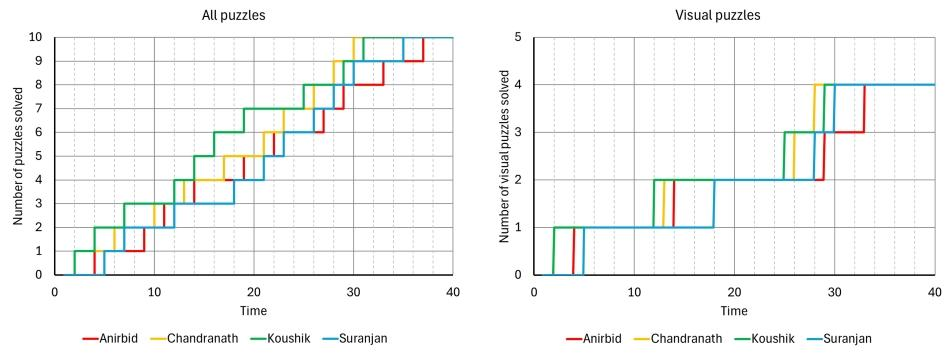
Anirbid, Chandranath, Koushik, and Suranjan participated in a puzzle solving competition. The competition comprised 10 puzzles that had to be solved in the same sequence, i.e., a competitor got access to a puzzle as soon as they solved the previous puzzle. Some of the puzzles were visual puzzles and the others were number-based puzzles. The winner of the competition was the one who solved all puzzles in the least time. The following charts describe their progress in the competition. The chart on the left shows the number of puzzles solved by each competitor at a given time (in minutes) after the start of the competition. The chart on the right shows the number of visual puzzles solved by each competitor at a given time (in minutes) after the start of the competition.

Passage 38 · CAT2024Slot1_DILR5 · 1 Questions
Six web surfers M, N, O, P, X, and Y each had 30 stars which they distributed among four bloggers A, B, C, and D. The number of stars received by A and B from the six web surfers is shown in the figure below.

The following additional facts are known regarding the number of stars received by the bloggers from the surfers.
1. The numbers of stars received by the bloggers from the surfers were all multiples of 5 (including 0).
2. The total numbers of stars received by the bloggers were the same.
3. Each blogger received a different number of stars from M.
4. Two surfers gave all their stars to a single blogger.
5. D received more stars than C from Y.
Passage 39 · CAT2025Slot3_DILR5 · 1 Questions
Anirbid, Chandranath, Koushik, and Suranjan participated in a puzzle solving competition. The competition comprised 10 puzzles that had to be solved in the same sequence, i.e., a competitor got access to a puzzle as soon as they solved the previous puzzle. Some of the puzzles were visual puzzles and the others were number-based puzzles. The winner of the competition was the one who solved all puzzles in the least time. The following charts describe their progress in the competition. The chart on the left shows the number of puzzles solved by each competitor at a given time (in minutes) after the start of the competition. The chart on the right shows the number of visual puzzles solved by each competitor at a given time (in minutes) after the start of the competition.

Passage 40 · CAT2024Slot1_DILR5 · 1 Questions
Six web surfers M, N, O, P, X, and Y each had 30 stars which they distributed among four bloggers A, B, C, and D. The number of stars received by A and B from the six web surfers is shown in the figure below.

The following additional facts are known regarding the number of stars received by the bloggers from the surfers.
1. The numbers of stars received by the bloggers from the surfers were all multiples of 5 (including 0).
2. The total numbers of stars received by the bloggers were the same.
3. Each blogger received a different number of stars from M.
4. Two surfers gave all their stars to a single blogger.
5. D received more stars than C from Y.
Passage 41 · CAT2025Slot3_DILR5 · 1 Questions
Anirbid, Chandranath, Koushik, and Suranjan participated in a puzzle solving competition. The competition comprised 10 puzzles that had to be solved in the same sequence, i.e., a competitor got access to a puzzle as soon as they solved the previous puzzle. Some of the puzzles were visual puzzles and the others were number-based puzzles. The winner of the competition was the one who solved all puzzles in the least time. The following charts describe their progress in the competition. The chart on the left shows the number of puzzles solved by each competitor at a given time (in minutes) after the start of the competition. The chart on the right shows the number of visual puzzles solved by each competitor at a given time (in minutes) after the start of the competition.

Passage 42 · CAT2024Slot1_DILR5 · 1 Questions
Six web surfers M, N, O, P, X, and Y each had 30 stars which they distributed among four bloggers A, B, C, and D. The number of stars received by A and B from the six web surfers is shown in the figure below.

The following additional facts are known regarding the number of stars received by the bloggers from the surfers.
1. The numbers of stars received by the bloggers from the surfers were all multiples of 5 (including 0).
2. The total numbers of stars received by the bloggers were the same.
3. Each blogger received a different number of stars from M.
4. Two surfers gave all their stars to a single blogger.
5. D received more stars than C from Y.
Passage 43 · CAT2025Slot3_DILR5 · 1 Questions
Anirbid, Chandranath, Koushik, and Suranjan participated in a puzzle solving competition. The competition comprised 10 puzzles that had to be solved in the same sequence, i.e., a competitor got access to a puzzle as soon as they solved the previous puzzle. Some of the puzzles were visual puzzles and the others were number-based puzzles. The winner of the competition was the one who solved all puzzles in the least time. The following charts describe their progress in the competition. The chart on the left shows the number of puzzles solved by each competitor at a given time (in minutes) after the start of the competition. The chart on the right shows the number of visual puzzles solved by each competitor at a given time (in minutes) after the start of the competition.

Passage 44 · CAT2024Slot1_DILR5 · 1 Questions
Six web surfers M, N, O, P, X, and Y each had 30 stars which they distributed among four bloggers A, B, C, and D. The number of stars received by A and B from the six web surfers is shown in the figure below.

The following additional facts are known regarding the number of stars received by the bloggers from the surfers.
1. The numbers of stars received by the bloggers from the surfers were all multiples of 5 (including 0).
2. The total numbers of stars received by the bloggers were the same.
3. Each blogger received a different number of stars from M.
4. Two surfers gave all their stars to a single blogger.
5. D received more stars than C from Y.
I. The number of stars received by C from M
II. The number of stars received by D from O
About CAT 2025 Slot 3 DILR
The DILR section of CAT 2025 Slot 3 was conducted on November 30, 2025, the last Sunday of November — consistent with IIM's scheduling across all recent years. The section contains 24 questions to be answered in 40 minutes, carrying 72 marks in total. There is no sectional time limit within the overall exam, but students choosing to switch sections mid-paper lose the ability to return — making pacing within DILR critical.
Passage Topics in CAT 2025 Slot 3 DILR
CAT 2025 Slot 3 DILR featured four reading comprehension passages and a standalone Verbal Ability block. The RC passages spanned complexity theory and global systems, the aesthetics of electronic music, the economics of income inequality, and the legal history of criminal responsibility — a typical CAT spread across the sciences, humanities, and social sciences. The VA section included Para Jumbles, Para Summary, and Odd Sentence Out questions, consistent with the pattern since CAT 2019.
CAT 2025 DILR Marking Scheme
- Correct answer (MCQ): +3 marks
- Wrong answer (MCQ): −1 mark
- Unattempted (MCQ): 0 marks
- TITA questions (if any): +3 correct, no negative marking
How to Use This Question Paper
Click any answer option to immediately check your answer. The correct option is highlighted in green; if you selected the wrong option, it is shown in red and the correct answer is revealed. A detailed explanation appears below each question after you answer it, along with statistics showing what percentage of students answered correctly in the actual exam.
The question navigator at the top of the page updates in real time — green bubbles indicate correct answers and red indicate wrong. Use this to spot weak areas at a glance. To practice under timed conditions, use the Take Full Mock button to attempt the complete CAT 2025 Slot 3 paper with a live timer and percentile benchmarking.
Tips for CAT DILR Preparation
Reading Comprehension accounts for roughly two-thirds of the DILR section. The passages in CAT are dense and argumentative — they reward close reading of the author's position rather than skimming for facts. Practising on past papers is the most reliable way to calibrate your reading speed, improve inference accuracy, and recognise the types of questions IIM setters favour. Use the answer statistics on this page to benchmark yourself; questions where more than 50% of test-takers answered correctly are ones you should aim to get right every time.