
CAT 2023 Slot 2 DILR Question Paper with Solutions
Passage 1 · CAT2023Slot2_DILR1 · 4 Questions
There are nine boxes arranged in a 3×3 array as shown in Tables 1 and 2. Each box contains three sacks. Each sack has a certain number of coins, between 1 and 9, both inclusive.
The average number of coins per sack in the boxes are all distinct integers. The total number of coins in each row is the same. The total number of coins in each column is also the same.
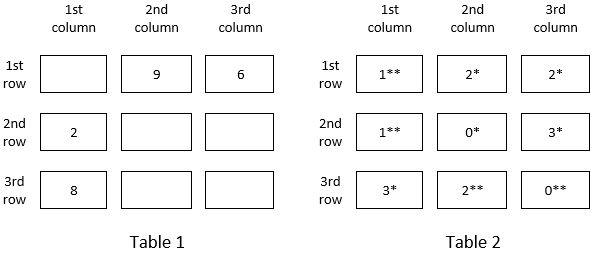
Table 1 gives information regarding the median of the numbers of coins in the three sacks in a box for some of the boxes. In Table 2 each box has a number which represents the number of sacks in that box having more than 5 coins. That number is followed by a * if the sacks in that box satisfy exactly one among the following three conditions, and it is followed by ** if two or more of these conditions are satisfied.
i) The minimum among the numbers of coins in the three sacks in the box is 1.
ii) The median of the numbers of coins in the three sacks is 1.
iii) The maximum among the numbers of coins in the three sacks in the box is 9.
Passage 2 · CAT2023Slot2_VARC1 · 1 Questions
The Second Hand September campaign, led by Oxfam ... seeks to encourage shopping at local organisations and charities as alternatives to fast fashion brands such as Primark and Boohoo in the name of saving our planet. As innocent as mindless scrolling through online shops may seem, such consumers are unintentionally—or perhaps even knowingly—contributing to an industry that uses more energy than aviation. ...
Brits buy more garments than any other country in Europe, so it comes as no shock that many of those clothes end up in UK landfills each year: 300,000 tonnes of them, to be exact. This waste of clothing is destructive to our planet, releasing greenhouse gasses as clothes are burnt as well as bleeding toxins and dyes into the surrounding soil and water. As ecologist Chelsea Rochman bluntly put it, "The mismanagement of our waste has even come back to haunt us on our dinner plate."
It's not surprising, then, that people are scrambling for a solution, the most common of which is second-hand shopping. Retailers selling consigned clothing are currently expanding at a rapid rate ... If everyone bought just one used item in a year, it would save 449 million lbs of waste, equivalent to the weight of 1 million Polar bears. "Thrifting" has increasingly become a trendy practice. London is home to many second-hand, or more commonly coined 'vintage', shops across the city from Bayswater to Brixton.
So you're cool and you care about the planet; you've killed two birds with one stone. But do people simply purchase a second-hand item, flash it on Instagram with #vintage and call it a day without considering whether what they are doing is actually effective?
According to a study commissioned by Patagonia, for instance, older clothes shed more microfibres. These can end up in our rivers and seas after just one wash due to the worn material, thus contributing to microfibre pollution. To break it down, the amount of microfibres released by laundering 100,000 fleece jackets is equivalent to as many as 11,900 plastic grocery bags, and up to 40 per cent of that ends up in our oceans. . . . So where does this leave second-hand consumers? [They would be well advised to buy] high-quality items that shed less and last longer [as this] combats both microfibre pollution and excess garments ending up in landfills. . . .
Luxury brands would rather not circulate their latest season stock around the globe to be sold at a cheaper price, which is why companies like ThredUP, a US fashion resale marketplace, have not yet caught on in the UK. There will always be a market for consignment but there is also a whole generation of people who have been taught that only buying new products is the norm; second-hand luxury goods are not in their psyche. Ben Whitaker, director at Liquidation Firm B-Stock, told Prospect that unless recycling becomes cost-effective and filters into mass production, with the right technology to partner it, "high-end retailers would rather put brand before sustainability."
Passage 3 · CAT2023Slot2_DILR1 · 1 Questions
There are nine boxes arranged in a 3×3 array as shown in Tables 1 and 2. Each box contains three sacks. Each sack has a certain number of coins, between 1 and 9, both inclusive.
The average number of coins per sack in the boxes are all distinct integers. The total number of coins in each row is the same. The total number of coins in each column is also the same.

Table 1 gives information regarding the median of the numbers of coins in the three sacks in a box for some of the boxes. In Table 2 each box has a number which represents the number of sacks in that box having more than 5 coins. That number is followed by a * if the sacks in that box satisfy exactly one among the following three conditions, and it is followed by ** if two or more of these conditions are satisfied.
i) The minimum among the numbers of coins in the three sacks in the box is 1.
ii) The median of the numbers of coins in the three sacks is 1.
iii) The maximum among the numbers of coins in the three sacks in the box is 9.
Passage 4 · CAT2023Slot2_DILR2 · 1 Questions
Three participants – Akhil, Bimal and Chatur participate in a random draw competition for five days. Every day, each participant randomly picks up a ball numbered between 1 and 9. The number on the ball determines his score on that day. The total score of a participant is the sum of his scores attained in the five days. The total score of a day is the sum of participants’ scores on that day. The 2-day average on a day, except on Day 1, is the average of the total scores of that day and of the previous day. For example, if the total scores of Day 1 and Day 2 are 25 and 20, then the 2-day average on Day 2 is calculated as 22.5. Table 1 gives the 2-day averages for Days 2 through 5.
| Table 1: 2-day averages for Days 2 through 5 | |||
|---|---|---|---|
| Day 2 | Day 3 | Day4 | Day 5 |
| 15 | 15.5 | 16 | 17 |
Participants are ranked each day, with the person having the maximum score being awarded the minimum rank (1) on that day. If there is a tie, all participants with the tied score are awarded the best available rank. For example, if on a day Akhil, Bimal, and Chatur score 8, 7 and 7 respectively, then their ranks will be 1, 2 and 2 respectively on that day. These ranks are given in Table 2.
| Table 2: Ranks of participants on each day | |||||
|---|---|---|---|---|---|
| Day 1 | Day 2 | Day 3 | Day 4 | Day 5 | |
| Akhil | 1 | 2 | 2 | 3 | 3 |
| Bimal | 2 | 3 | 2 | 1 | 1 |
| Chatur | 3 | 1 | 1 | 2 | 2 |
The following information is also known.
1. Chatur always scores in multiples of 3. His score on Day 2 is the unique highest score in the competition. His minimum score is observed only on Day 1, and it matches Akhil’s score on Day 4.
2. The total score on Day 3 is the same as the total score on Day 4.
3. Bimal’s scores are the same on Day 1 and Day 3.
Passage 5 · CAT2023Slot2_VARC2 · 1 Questions
Over the past four centuries liberalism has been so successful that it has driven all its opponents off the battlefield. Now it is disintegrating, destroyed by a mix of hubris and internal contradictions, according to Patrick Deneen, a professor of politics at the University of Notre Dame. . . . Equality of opportunity has produced a new meritocratic aristocracy that has all the aloofness of the old aristocracy with none of its sense of noblesse oblige. Democracy has degenerated into a theatre of the absurd. And technological advances are reducing ever more areas of work into meaningless drudgery. "The gap between liberalism's claims about itself and the lived reality of the citizenry" is now so wide that "the lie can no longer be accepted," Mr Deneen writes. What better proof of this than the vision of 1,000 private planes whisking their occupants to Davos to discuss the question of "creating a shared future in a fragmented world"? . . .
Deneen does an impressive job of capturing the current mood of disillusionment, echoing left-wing complaints about rampant commercialism, right-wing complaints about narcissistic and bullying students, and general worries about atomisation and selfishness. But when he concludes that all this adds up to a failure of liberalism, is his argument convincing? . . . He argues that the essence of liberalism lies in freeing individuals from constraints. In fact, liberalism contains a wide range of intellectual traditions which provide different answers to the question of how to trade off the relative claims of rights and responsibilities, individual expression and social ties. . . . liberals experimented with a range of ideas from devolving power from the centre to creating national education systems.
Mr Deneen's fixation on the essence of liberalism leads to the second big problem of his book: his failure to recognise liberalism's ability to reform itself and address its internal problems. The late 19th century saw America suffering from many of the problems that are reappearing today, including the creation of a business aristocracy, the rise of vast companies, the corruption of politics and the sense that society was dividing into winners and losers. But a wide variety of reformers, working within the liberal tradition, tackled these problems head on. Theodore Roosevelt took on the trusts. Progressives cleaned up government corruption. University reformers modernised academic syllabuses and built ladders of opportunity. Rather than dying, liberalism reformed itself.
Mr Deneen is right to point out that the record of liberalism in recent years has been dismal. He is also right to assert that the world has much to learn from the premodern notions of liberty as self-mastery and self-denial. The biggest enemy of liberalism is not so much atomisation but old-fashioned greed, as members of the Davos elite pile their plates ever higher with perks and share options. But he is wrong to argue that the only way for people to liberate themselves from the contradictions of liberalism is "liberation from liberalism itself". The best way to read "Why Liberalism Failed" is not as a funeral oration but as a call to action: up your game, or else.
Passage 6 · CAT2023Slot2_DILR2 · 4 Questions
Three participants – Akhil, Bimal and Chatur participate in a random draw competition for five days. Every day, each participant randomly picks up a ball numbered between 1 and 9. The number on the ball determines his score on that day. The total score of a participant is the sum of his scores attained in the five days. The total score of a day is the sum of participants’ scores on that day. The 2-day average on a day, except on Day 1, is the average of the total scores of that day and of the previous day. For example, if the total scores of Day 1 and Day 2 are 25 and 20, then the 2-day average on Day 2 is calculated as 22.5. Table 1 gives the 2-day averages for Days 2 through 5.
| Table 1: 2-day averages for Days 2 through 5 | |||
|---|---|---|---|
| Day 2 | Day 3 | Day4 | Day 5 |
| 15 | 15.5 | 16 | 17 |
Participants are ranked each day, with the person having the maximum score being awarded the minimum rank (1) on that day. If there is a tie, all participants with the tied score are awarded the best available rank. For example, if on a day Akhil, Bimal, and Chatur score 8, 7 and 7 respectively, then their ranks will be 1, 2 and 2 respectively on that day. These ranks are given in Table 2.
| Table 2: Ranks of participants on each day | |||||
|---|---|---|---|---|---|
| Day 1 | Day 2 | Day 3 | Day 4 | Day 5 | |
| Akhil | 1 | 2 | 2 | 3 | 3 |
| Bimal | 2 | 3 | 2 | 1 | 1 |
| Chatur | 3 | 1 | 1 | 2 | 2 |
The following information is also known.
1. Chatur always scores in multiples of 3. His score on Day 2 is the unique highest score in the competition. His minimum score is observed only on Day 1, and it matches Akhil’s score on Day 4.
2. The total score on Day 3 is the same as the total score on Day 4.
3. Bimal’s scores are the same on Day 1 and Day 3.
Passage 7 · CAT2023Slot2_DILR3 · 4 Questions
Odsville has five firms – Alfloo, Bzygoo, Czechy, Drjbna and Elavalaki. Each of these firms was founded in some year and also closed down a few years later.
Each firm raised Rs. 1 crore in its first and last year of existence. The amount each firm raised every year increased until it reached a maximum, and then decreased until the firm closed down. No firm raised the same amount of money in two consecutive years. Each annual increase and decrease was either by Rs. 1 crore or by Rs. 2 crores.
The table below provides partial information about the five firms.
| Firm | First year of existence | Last year of existence | Total amount raised (Rs. crores) |
|---|---|---|---|
| Alfloo | 2009 | 2016 | 21 |
| Bzygoo | 2012 | 2015 | |
| Czechy | 2013 | 9 | |
| Drjbna | 2011 | 2015 | 10 |
| Elavalaki | 2010 | 13 |
Passage 8 · CAT2023Slot2_VARC4 · 1 Questions
Umberto Eco, an Italian writer, was right when he said the language of Europe is translation. Netflix and other deep-pocketed global firms speak it well. Just as the EU employs a small army of translators and interpreters to turn intricate laws or impassioned speeches of Romanian MEPs into the EU's 24 official languages, so do the likes of Netflix. It now offers dubbing in 34 languages and subtitling in a few more. . . .
The economics of European productions are more appealing, too. American audiences are more willing than before to give dubbed or subtitled viewing a chance. This means shows such as "Lupin", a French crime caper on Netflix, can become global hits. ... In 2015, about 75% of Netflix's original content was American; now the figure is half, according to Ampere, a media-analysis company. Netflix has about 100 productions under way in Europe, which is more than big public broadcasters in France or Germany. . . .
Not everything works across borders. Comedy sometimes struggles. Whodunits and bloodthirsty maelstroms between arch Romans and uppity tribesmen have a more universal appeal. Some do it better than others. Barbarians aside, German television is not always built for export, says one executive, being polite. A bigger problem is that national broadcasters still dominate. Streaming services, such as Netflix or Disney+, account for about a third of all viewing hours, even in markets where they are well-established. Europe is an ageing continent. The generation of teens staring at phones is outnumbered by their elders who prefer to gawp at the box.
In Brussels and national capitals, the prospect of Netflix as a cultural hegemon is seen as a threat. "Cultural sovereignty" is the watchword of European executives worried that the Americans will eat their lunch. To be fair, Netflix content sometimes seems stuck in an uncanny valley somewhere in the mid-Atlantic, with local quirks stripped out. Netflix originals tend to have fewer specific cultural references than shows produced by domestic rivals, according to Enders, a market analyst. The company used to have an imperial model of commissioning, with executives in Los Angeles cooking up ideas French people might like. Now Netflix has offices across Europe. But ultimately the big decisions rest with American executives. This makes European politicians nervous.
They should not be. An irony of European integration is that it is often American companies that facilitate it. Google Translate makes European newspapers comprehensible, even if a little clunky, for the continent's non-polyglots. American social-media companies make it easier for Europeans to talk politics across borders. (That they do not always like to hear what they say about each other is another matter.) Now Netflix and friends pump the same content into homes across a continent, making culture a cross-border endeavour, too. If Europeans are to share a currency, bail each other out in times of financial need and share vaccines in a pandemic, then they need to have something in common—even if it is just bingeing on the same series. Watching fictitious northern and southern Europeans tear each other apart 2,000 years ago beats doing so in reality.
Passage 9 · CAT2023Slot2_DILR3 · 1 Questions
Odsville has five firms – Alfloo, Bzygoo, Czechy, Drjbna and Elavalaki. Each of these firms was founded in some year and also closed down a few years later.
Each firm raised Rs. 1 crore in its first and last year of existence. The amount each firm raised every year increased until it reached a maximum, and then decreased until the firm closed down. No firm raised the same amount of money in two consecutive years. Each annual increase and decrease was either by Rs. 1 crore or by Rs. 2 crores.
The table below provides partial information about the five firms.
| Firm | First year of existence | Last year of existence | Total amount raised (Rs. crores) |
|---|---|---|---|
| Alfloo | 2009 | 2016 | 21 |
| Bzygoo | 2012 | 2015 | |
| Czechy | 2013 | 9 | |
| Drjbna | 2011 | 2015 | 10 |
| Elavalaki | 2010 | 13 |
Passage 10 · CAT2023Slot2_DILR4 · 5 Questions
Anjali, Bipasha, and Chitra visited an entertainment park that has four rides. Each ride lasts one hour and can accommodate one visitor at one point. All rides begin at 9 am and must be completed by 5 pm except for Ride-3, for which the last ride has to be completed by 1 pm. Ride gates open every 30 minutes, e.g. 10 am, 10:30 am, and so on. Whenever a ride gate opens, and there is no visitor inside, the first visitor waiting in the queue buys the ticket just before taking the ride. The ticket prices are Rs. 20, Rs. 50, Rs. 30 and Rs. 40 for Rides 1 to 4, respectively. Each of the three visitors took at least one ride and did not necessarily take all rides. None of them took the same ride more than once. The movement time from one ride to another is negligible, and a visitor leaves the ride immediately after the completion of the ride. No one takes a break inside the park unless mentioned explicitly.
The following information is also known.
1. Chitra never waited in the queue and completed her visit by 11 am after spending Rs. 50 to pay for the ticket(s).
2. Anjali took Ride-1 at 11 am after waiting for 30 mins for Chitra to complete it. It was the only ride where Anjali waited.
3. Bipasha began her first of three rides at 11:30 am. All three visitors incurred the same amount of ticket expense by 12:15 pm.
4. The last ride taken by Anjali and Bipasha was the same, where Bipasha waited 30 mins for Anjali to complete her ride. Before standing in the queue for that ride, Bipasha took a 1-hour coffee break after completing her previous ride.
About CAT 2023 Slot 2 DILR
The DILR section of CAT 2023 Slot 2 was conducted on November 30, 2023, the last Sunday of November — consistent with IIM's scheduling across all recent years. The section contains 24 questions to be answered in 40 minutes, carrying 72 marks in total. There is no sectional time limit within the overall exam, but students choosing to switch sections mid-paper lose the ability to return — making pacing within DILR critical.
Passage Topics in CAT 2023 Slot 2 DILR
CAT 2023 Slot 2 DILR featured four reading comprehension passages and a standalone Verbal Ability block. The RC passages spanned complexity theory and global systems, the aesthetics of electronic music, the economics of income inequality, and the legal history of criminal responsibility — a typical CAT spread across the sciences, humanities, and social sciences. The VA section included Para Jumbles, Para Summary, and Odd Sentence Out questions, consistent with the pattern since CAT 2019.
CAT 2023 DILR Marking Scheme
- Correct answer (MCQ): +3 marks
- Wrong answer (MCQ): −1 mark
- Unattempted (MCQ): 0 marks
- TITA questions (if any): +3 correct, no negative marking
How to Use This Question Paper
Click any answer option to immediately check your answer. The correct option is highlighted in green; if you selected the wrong option, it is shown in red and the correct answer is revealed. A detailed explanation appears below each question after you answer it, along with statistics showing what percentage of students answered correctly in the actual exam.
The question navigator at the top of the page updates in real time — green bubbles indicate correct answers and red indicate wrong. Use this to spot weak areas at a glance. To practice under timed conditions, use the Take Full Mock button to attempt the complete CAT 2023 Slot 2 paper with a live timer and percentile benchmarking.
Tips for CAT DILR Preparation
Reading Comprehension accounts for roughly two-thirds of the DILR section. The passages in CAT are dense and argumentative — they reward close reading of the author's position rather than skimming for facts. Practising on past papers is the most reliable way to calibrate your reading speed, improve inference accuracy, and recognise the types of questions IIM setters favour. Use the answer statistics on this page to benchmark yourself; questions where more than 50% of test-takers answered correctly are ones you should aim to get right every time.