CAT 2025 Slot 1 DILR Question Paper with Solutions
Passage 1 · CAT2025Slot1_DILR1 · 4 Questions
A round table has seven chairs around it. The chairs are numbered 1 through 7 in a clockwise direction. Four friends, Aslam, Bashir, Chhavi, and Davies, sit on four of the chairs. In the starting position, Aslam and Chhavi are sitting next to each other, while for Bashir as well as Davies, there are empty chairs on either side of the chairs that are sitting on.
The friends take turns moving either clockwise or counterclockwise from their chair. The friend who has to move in a turn occupies the first empty chair in whichever direction (s)he chooses to move. Aslam moves first (Turn 1), followed by Bashir, Chhavi, and Davies (Turns 2, 3, and 4, respectively). Then Aslam moves again followed by Bashir, and Chhavi (Turns 5, 6, and 7, respectively).
The following information is known.
1. The four friends occupy adjacent chairs only at the end of Turn 2 and Turn 6.
2. Davies occupies Chair 2 after Turn 1 and Chair 4 after Turn 5, and Chhavi occupies Chair 7 after Turn 2.
Passage 2 · CAT2025Slot1_DILR2 · 4 Questions
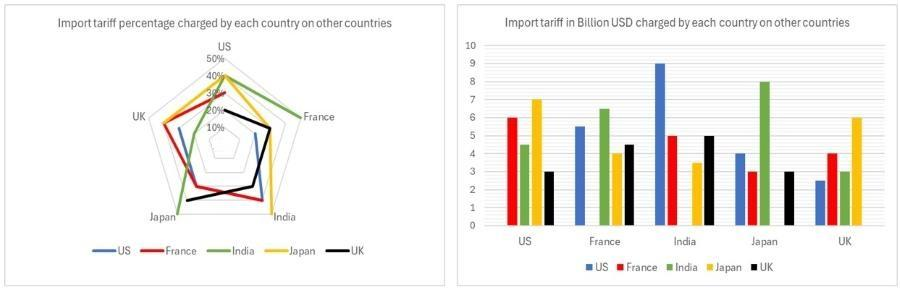
Five countries engage in trade with each other. Each country levies import tariffs on the other countries. The import tariff levied by Country X on Country Y is calculated by multiplying the corresponding tariff percentage with the total imports of Country X from Country Y.
The radar chart below depicts different import tariff percentages charged by each of the five countries on the others. For example, US (the blue line in the chart) charges 20%, 40%, 30%, and 30% import tariff percentages on imports from France, India, Japan, and UK, respectively. The bar chart depicts the import tariffs levied by each county on other countries. For example, US charged import tariff of 3 billion USD on UK.

Assume that imports from one country to another equals the exports from the latter to the former.
The trade surplus of Country X with Country Y is defined as follows.
.
A negative trade surplus is called trade deficit.
Passage 3 · CAT2025Slot1_DILR3 · 5 Questions
A train travels from Station A to Station E, passing through stations B, C, and D, in that order. The train has a seating capacity of 200. A ticket may be booked from any station to any other station ahead on the route, but not to any earlier station.
A ticket from one station to another reserves one seat on every intermediate segment of the route. For example, a ticket from B to E reserves a seat in the intermediate segments B – C, C – D, and D – E.
The occupancy factor for a segment is the total number of seats reserved in the segment as a percentage of the seating capacity. The total number of seats reserved for any segment cannot exceed 200.
The following information is known.
1. Segment C – D had an occupancy factor of 95%. Only segment B – C had a higher occupancy factor.
2. Exactly 40 tickets were booked from B to C and 30 tickets were booked from B to E.
3. Among the seats reserved on segment D – E, exactly four-sevenths were from stations before C.
4. The number of tickets booked from A to C was equal to that booked from A to E, and it was higher than that from B to E.
5. No tickets were booked from A to B, from B to D and from D to E.
6. The number of tickets booked for any segment was a multiple of 10.
Passage 4 · CAT2025Slot1_DILR4 · 4 Questions
Alia, Badal, Clive, Dilshan, and Ehsaan played a game in which each asks a unique question to all the others and they respond by tapping their feet, either once or twice or thrice. One tap means “Yes”, two taps mean “No”, and three taps mean “Maybe”.
A total of 40 taps were heard across the five questions. Each question received at least one “Yes”, one “No”, and one “Maybe.”
The following information is known.
1. Alia tapped a total of 6 times and received 9 taps to her question. She responded “Yes” to the questions asked by both Clive and Dilshan.
2. Dilshan and Ehsaan tapped a total of 11 and 9 times respectively. Dilshan responded “No” to Badal.
3. Badal, Dilshan, and Ehsaan received equal number of taps to their respective questions.
4. No one responded “Yes” more than twice.
5. No one’s answer to Alia’s question matched the answer that Alia gave to that person’s question. This was also true for Ehsaan.
6. Clive tapped more times in total than Badal.
Passage 5 · CAT2025Slot1_DILR5 · 5 Questions
At InnovateX, six employees, Asha, Bunty, Chintu, Dolly, Eklavya, and Falguni, were split into two groups of three each: Elite led by Manager Kuku, and Novice led by Manager Lalu.
At the end of each quarter, Kuku and Lalu handed out ratings to all members in their respective groups. In each group, each employee received a distinct integer rating from 1 to 3.
The score for an employee at the end of a quarter is defined as their cumulative rating from the beginning of the year. At the end of each quarter the employee in Novice with the highest score was promoted to Elite, and the employee in Elite with the minimum score was demoted to Novice. If there was a tie in scores, the employee with a higher rating in the latest quarter was ranked higher.
1. Asha, Bunty, and Chintu were in Elite at the beginning of Quarter 1. All of them were in Novice at the beginning of Quarter 4.
2. Dolly and Falguni were the only employees who got the same rating across all the quarters.
3. The following is known about ratings given by Lalu:
• Bunty received a rating of 1 in Quarter 2.
• Asha and Dolly received ratings of 1 and 2, respectively, in Quarter 3.
I. Asha received a rating of 2 in Quarter 1.
II. Asha received a rating of 1 in Quarter 2.
About CAT 2025 Slot 1 DILR
The DILR section of CAT 2025 Slot 1 was conducted on November 30, 2025, the last Sunday of November — consistent with IIM's scheduling across all recent years. The section contains 24 questions to be answered in 40 minutes, carrying 72 marks in total. There is no sectional time limit within the overall exam, but students choosing to switch sections mid-paper lose the ability to return — making pacing within DILR critical.
Passage Topics in CAT 2025 Slot 1 DILR
CAT 2025 Slot 1 DILR featured four reading comprehension passages and a standalone Verbal Ability block. The RC passages spanned complexity theory and global systems, the aesthetics of electronic music, the economics of income inequality, and the legal history of criminal responsibility — a typical CAT spread across the sciences, humanities, and social sciences. The VA section included Para Jumbles, Para Summary, and Odd Sentence Out questions, consistent with the pattern since CAT 2019.
CAT 2025 DILR Marking Scheme
- Correct answer (MCQ): +3 marks
- Wrong answer (MCQ): −1 mark
- Unattempted (MCQ): 0 marks
- TITA questions (if any): +3 correct, no negative marking
How to Use This Question Paper
Click any answer option to immediately check your answer. The correct option is highlighted in green; if you selected the wrong option, it is shown in red and the correct answer is revealed. A detailed explanation appears below each question after you answer it, along with statistics showing what percentage of students answered correctly in the actual exam.
The question navigator at the top of the page updates in real time — green bubbles indicate correct answers and red indicate wrong. Use this to spot weak areas at a glance. To practice under timed conditions, use the Take Full Mock button to attempt the complete CAT 2025 Slot 1 paper with a live timer and percentile benchmarking.
Tips for CAT DILR Preparation
Reading Comprehension accounts for roughly two-thirds of the DILR section. The passages in CAT are dense and argumentative — they reward close reading of the author's position rather than skimming for facts. Practising on past papers is the most reliable way to calibrate your reading speed, improve inference accuracy, and recognise the types of questions IIM setters favour. Use the answer statistics on this page to benchmark yourself; questions where more than 50% of test-takers answered correctly are ones you should aim to get right every time.